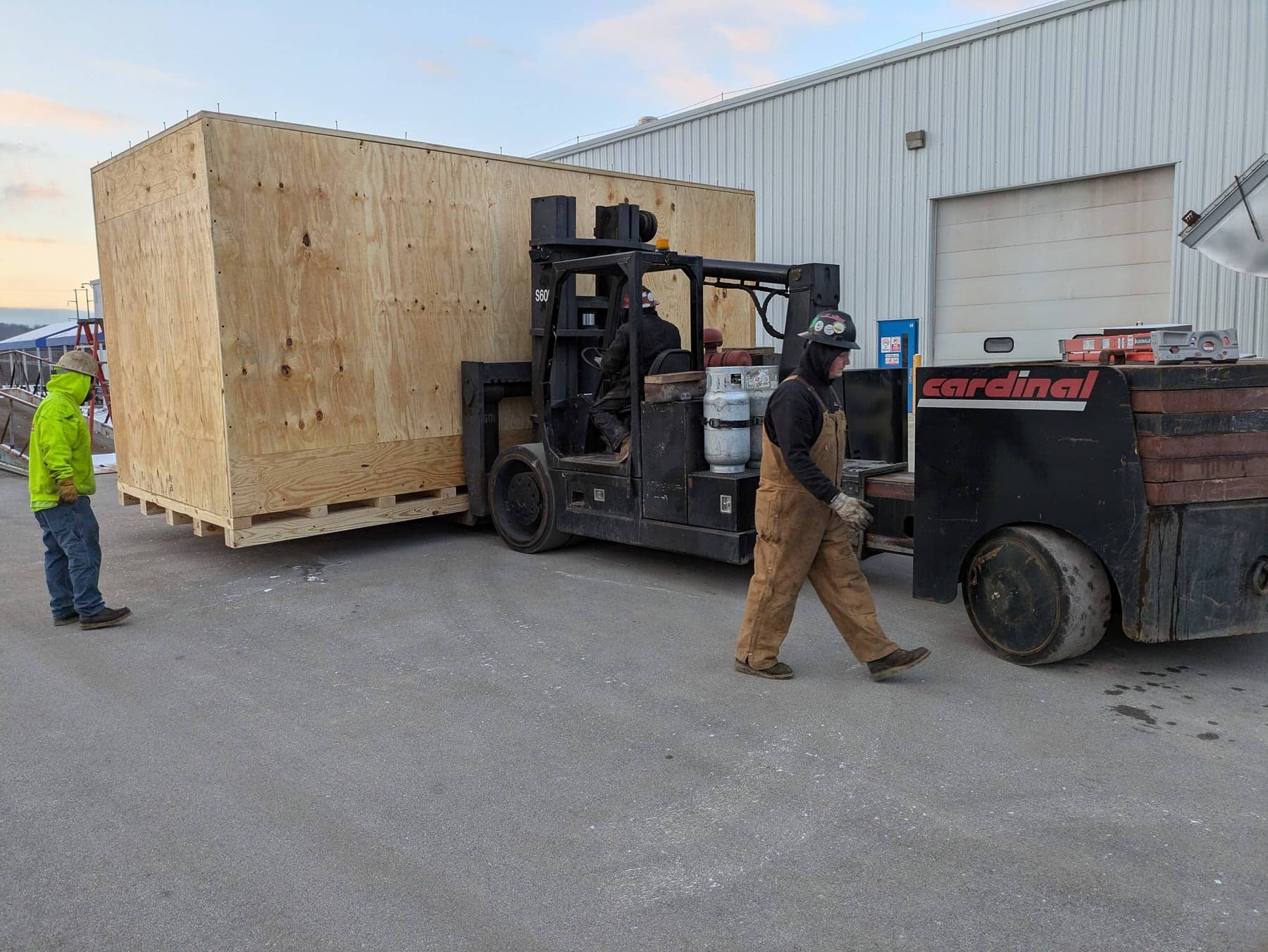
What is this service?
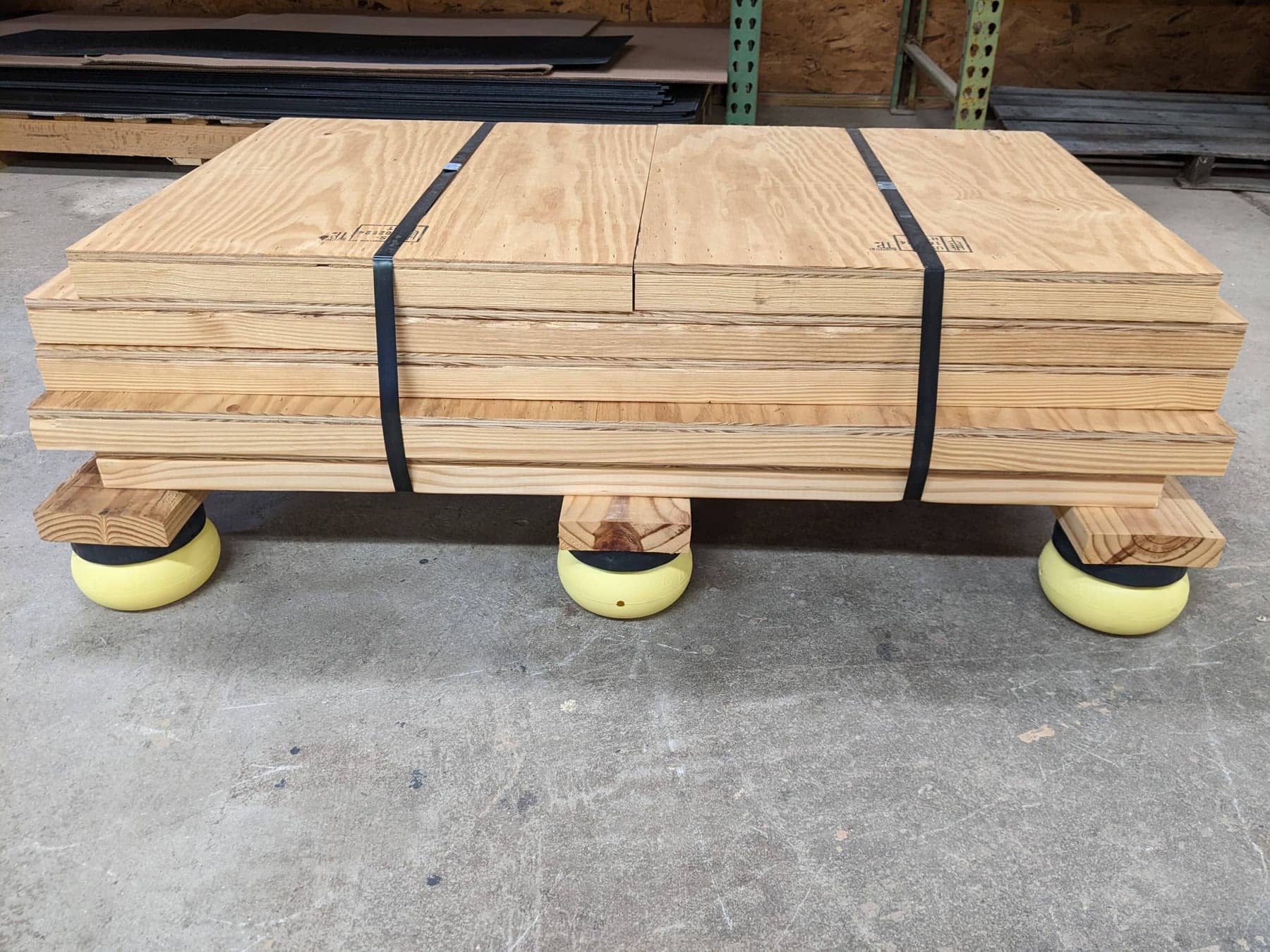
Crating builds a protective box of timber framing and sheathing around the cargo; skidding fixes the cargo onto a base of heavy-section timber beams bolted or tied beneath it. In international shipments, solid-timber parts must be treated and marked under ISPM 15.
Who and which cargo is it for?
- Machinery, machine tools and production-line equipment
- Electrical cabinets and sensitive devices
- Heavy spare parts and moulds
- Export cargo that must be stackable
Scope of service
- Crate design by cargo size, weight and centre of gravity
- Skid and forklift-entry base
- Open (framed) or closed (sheathed) crate
- Cargo fixed to the skid by bolting or tie-downs
- Combined with padding, VCI and barrier foil
- Centre-of-gravity, lifting-point and handling marks
Typical operation stages
- 1
Data
Dimensions, weight, centre of gravity and attachment points are taken.
- 2
Design
Skid sections, crate type and internal securing are defined.
- 3
Build
Base and panels are made from ISPM 15-marked timber and suitable panel material.
- 4
Securing
The cargo is fixed to the skid; protective packing is added where needed.
- 5
Closing
Panels are fitted and banding added where required.
- 6
Marking
Centre of gravity, lifting points and handling symbols are marked.
Methods and materials
Open (framed) crate
For cargo with lower impact risk where visibility and weight matter.
Closed crate
Plywood or OSB sheathing for full protection against dust, water and impact.
Skid
Base that carries heavy cargo and enables forklift/crane handling; sections are sized to the weight.
Marking
Handling symbols, centre of gravity and lifting points are clearly marked.
Safety and checkpoints
- No lift takes place before the cargo is fixed to the skid.
- Lifting points are clearly marked outside the crate; lifting from the wrong point can cause tipping.
- Cutting and assembly tools are used by trained staff only.
Example scenario
Example scenario (illustrative): for a 4.2-tonne injection mould, a three-beam skid positioned to the centre of gravity is built, the mould is bolted to it, covered with VCI film and enclosed in a plywood-sheathed crate, with centre-of-gravity and forklift-entry marks on the outside.
Locations served
Our İzmit / Kocaeli based team works at ports and industrial sites around Kocaeli and the Gulf of İzmit. For operations outside Kocaeli, state the location in your request.
Frequently asked questions
Does using plywood remove the ISPM 15 requirement?
Processed wood such as plywood and OSB is outside ISPM 15, but solid-timber skids, chocks and framing are covered and must be marked.
Closed or open crate?
A closed crate is recommended when dust, water and impact risks are high or the crate will be stacked. An open crate can be enough for robust cargo that needs to stay visible.
Is the crate designed around the cargo?
Yes. A proper crate cannot be designed without dimensions, centre of gravity and attachment points; the manufacturer's drawing is the best starting point.