What is this service?
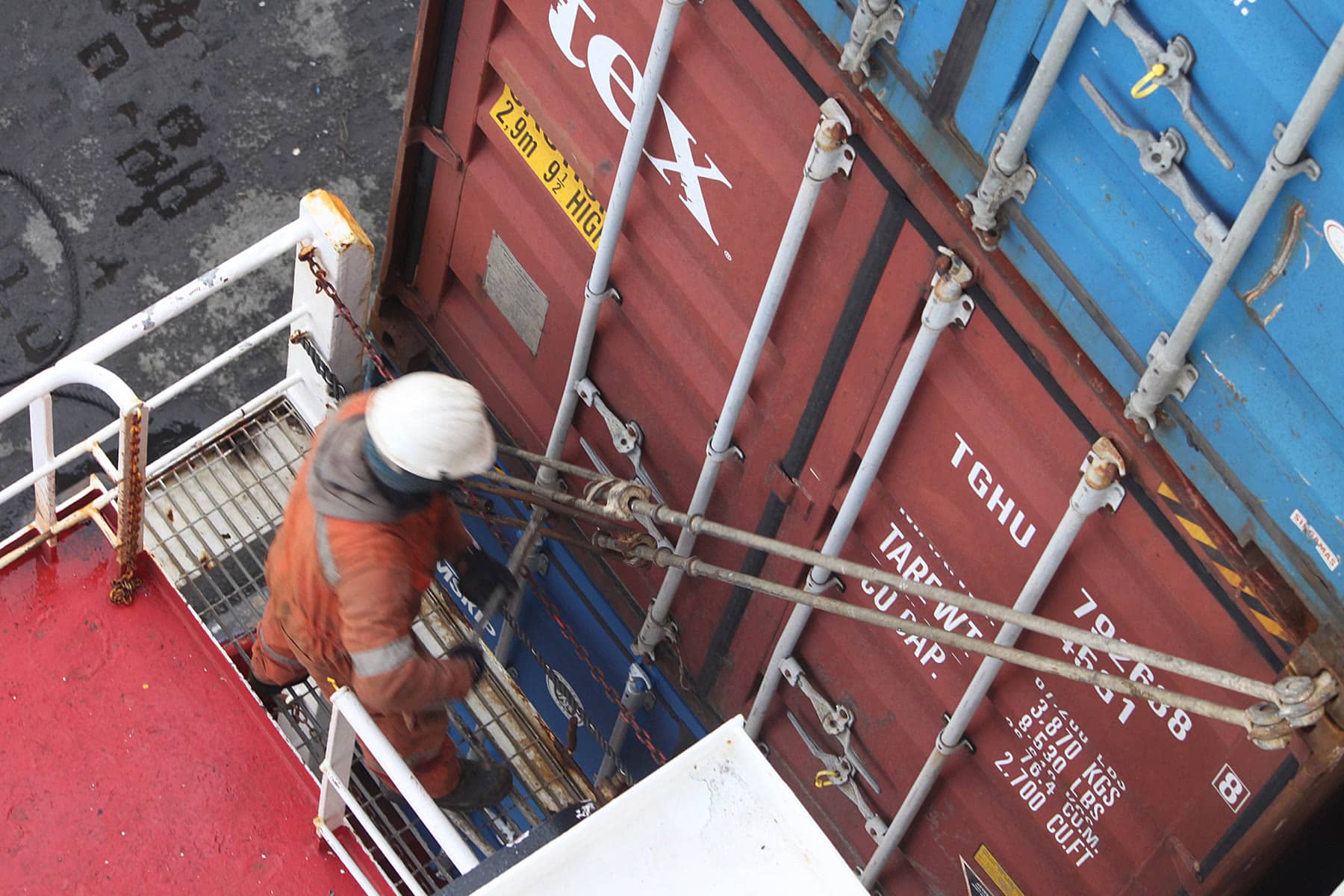
Lashing is the process of restraining cargo against the longitudinal, transverse and vertical forces that act on it in transit, using chains, steel wire rope, polyester webbing, tensioners and chocks. The aim is not simply to tie the cargo down, but to assess the cargo, its securing points and the transport unit together so those forces are carried safely.
Who and which cargo is it for?
- Manufacturers shipping exports or receiving imports
- Field work carried out on behalf of forwarders and ship agents
- Machinery, energy equipment, structural steel and automotive shipments
- Cargo moved inside containers, on flat racks, in open tops or on deck
- Construction machinery and vehicle shipments
Scope of service
- Preliminary assessment from cargo data, drawings and photos
- Check of securing points and the transport unit's suitability
- Choice of securing method and materials for the cargo type
- Chocking, blocking and dunnage to close movement gaps
- On-site application and tensioning of the lashings
- Photo-documented check after completion
Typical operation stages
- 1
Survey
We collect dimensions, weight, centre of gravity, lifting and lashing points and the transport unit details.
- 2
Analysis
The forces the cargo will face are assessed against the route and mode — sea, road or combined.
- 3
Preparation
Securing method, equipment type and quantity are set; rated-capacity labels on equipment are checked.
- 4
Application
The cargo is positioned, blocked, lashed and the lashings are tensioned evenly.
- 5
Check
Tension, edge protection, chafe points and locking devices get a final check.
- 6
Reporting
Photos of the finished securing and the list of materials used are shared with the client.
Methods and materials
Blocking (form-fit)
Bracing the cargo against the unit's walls, chocks or other packages so it physically cannot move. The first choice wherever possible.
Direct lashing
Chain, wire rope or webbing from a lashing point on the cargo to one on the transport unit, sized to the calculated force.
Frictional (top-over) lashing
Lashings that press the cargo down to increase friction — more effective with anti-slip mats.
Combined solutions
Most heavy units need blocking, direct lashing and dunnage used together.
Safety and checkpoints
- Equipment is only used with a legible rated-capacity label; damaged gear is taken out of service.
- Edge protectors are used on sharp corners so webbing and rope are not cut.
- Site rules cover work at height, standing clear of suspended loads and recoil during tensioning.
- If the capacity of a lashing point is unknown, work does not start until the client supplies the data.
Example scenario
Example scenario (illustrative, not a real project): an 18-tonne press frame is to ship on a 40' flat rack. In the pre-assessment, the manufacturer confirms whether the lifting lugs may be used as lashing points, the centre of gravity is aligned with the middle of the rack, the unit is blocked with timber chocks and cross-chain lashings are tensioned evenly.
Locations served
Our İzmit / Kocaeli based team works at ports and industrial sites around Kocaeli and the Gulf of İzmit. For operations outside Kocaeli, state the location in your request.
Frequently asked questions
What do you need for a lashing quote?
Dimensions, gross weight, centre of gravity if known, lifting and lashing points, the transport unit (20'/40', flat rack, open top, etc.), loading location and date. Photos or drawings speed up the assessment.
Do you supply the lashing materials?
Material supply depends on the scope and is itemised in the quote. The type and rated capacity of every item are shared before work starts.
What is the difference between lashing and dunnage?
Lashing ties the cargo down with securing equipment; dunnage fills gaps between cargo and walls or between packages to limit movement. Most jobs use both.
Do you document the work?
Yes — a photo-documented completion check and a materials list. An independent survey report is a separate service and is planned on its own.